Black Rhino in the Ngorongoro Crater: Your Best Chance in Tanzania
Black rhinos are the hardest of the Big Five to see. The Ngorongoro Crater is one of the best places in East Africa to find them. Here is why, and how.
Of the Big Five, the rhino is the one most travellers miss. Black rhinos are rare, shy and often hidden in thick bush. But in Tanzania there is one place where your chances are genuinely good: the floor of the Ngorongoro Crater, where a small, well-protected population lives on open grassland.
The black rhino: a quick introduction
The black rhino is one of Africa's two rhino species. Despite the name, it is grey, like the white rhino. The easiest way to tell them apart is the lip: the black rhino has a pointed, hooked upper lip for browsing leaves and twigs, while the white rhino has a wide, square lip for grazing grass. Black rhinos are usually solitary or seen as a mother with a calf.
Poaching for rhino horn devastated populations across Africa in the 20th century. Black rhinos are listed as critically endangered, and every individual matters.
Why the Ngorongoro Crater?
- Protection: the crater is a closed, closely guarded area, and its rhinos are carefully monitored by rangers.
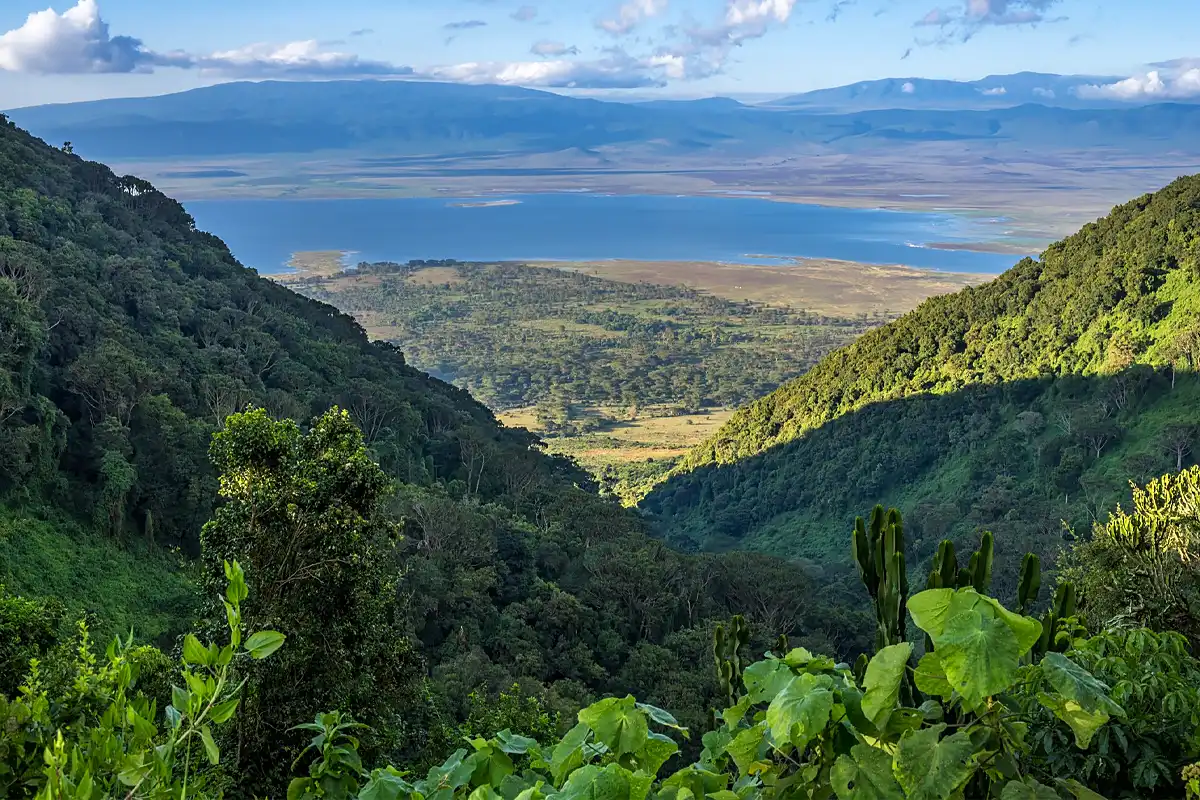
- Open landscape: the crater floor is largely open grassland, so rhinos are easier to see than in the dense bush where they live elsewhere.
- Compact area: the crater floor is about 260 km², small enough to explore in a day.
Rhinos in the crater are usually seen at a distance, often grazing or resting on the open plains or near the edges of the Lerai Forest. Good binoculars and a zoom lens help a lot.
Where else in Tanzania?
Black rhinos also live in parts of the Serengeti, especially around the Moru kopjes, but sightings there are rare. Some other protected areas, such as Mkomazi National Park, have rhino sanctuaries with conservation programmes. For most travellers, the Ngorongoro Crater remains the best bet.
Tips for spotting rhino
- Go down early. The first hours of the morning are cooler, the light is good, and there are fewer vehicles.
- Bring binoculars. Rhinos are often spotted as a grey shape far across the grassland.
- Ask your guide. Guides share news of recent sightings and know the rhinos' favourite areas.
- Be patient and quiet. Rhinos have poor eyesight but excellent hearing and smell.
- Keep your distance. Vehicles must stay on the tracks and give rhinos space; never ask your guide to drive closer than the rules allow.
How visitors help
Conservation fees from the crater help pay for rangers, monitoring and anti-poaching work. By visiting responsibly and travelling with licensed operators, you contribute to protecting the rhinos for the future.
Plan your crater visit
The crater fits into almost any northern safari. See our Ngorongoro Crater guide, the Ngorongoro Crater Day Trip and the 3-Day Ngorongoro Crater Luxury Safari, and read where to find the rest of the Big Five in Tanzania. Then tell us your dates.
A short history of rhinos in Tanzania
In the 1960s and 1970s, black rhinos were common in parts of northern Tanzania, including the Ngorongoro Crater and the Serengeti. Poaching in the following decades reduced them to a handful of animals. Protection, monitoring and in some places reintroductions have since helped numbers recover slowly. Today every rhino in the crater is known to the rangers, who track their movements to keep them safe.
What else to look for in the crater
While you search for rhinos, the crater offers plenty more: lions and spotted hyenas on the grassland, elephant bulls with large tusks near the Lerai Forest, buffalo herds, hippos in the pools, and flamingos on Lake Magadi when conditions are right. Even without a rhino, a crater day is one of the great safari experiences.
Photography tips
Rhinos in the crater are often far away. A long lens (300–600 mm) helps, as do a bean bag to steady it and an early start for soft light. Patience pays off: rhinos sometimes walk slowly towards the track over the course of an hour.
The crater's other residents
The Ngorongoro Crater is famous for its density of wildlife. On a single day you may see lions (sometimes with large, dark-maned males), spotted hyenas, golden and black-backed jackals, servals, elephant bulls, buffalo, zebras, wildebeest, Grant's and Thomson's gazelles, hippos and many birds, from ostriches to grey crowned cranes. What you won't see is giraffes: the crater walls are too steep for them.
Planning a crater day for rhino
- Stay on the rim or in Karatu the night before, so you can go down early.
- Plan a full day on the crater floor with a picnic, within the time limit for the crater.
- Combine with Tarangire and the Serengeti for the other members of the Big Five.
- Visit in the green season (November–May) for fewer vehicles, or the dry season for clear views.
Rhino etiquette
Rhinos are easily stressed. Guides keep a respectful distance, switch off the engine when appropriate and keep voices low. Please never ask your guide to leave the track or get closer than the rules allow; doing so can stress the animal and risks fines for the guide. Patience is usually rewarded: rhinos sometimes move slowly towards the track on their own.
A conservation success worth seeing
Seeing a black rhino in the wild is a reminder of how close the species came to disappearing, and of the work that keeps it here today. When you visit, you are part of the reason these animals are protected.
Frequently asked questions
Where can I see black rhino in Tanzania?
The Ngorongoro Crater is the best place. Rhinos also live in parts of the Serengeti, especially around the Moru kopjes, but sightings there are rare.
Will I definitely see a rhino in the Ngorongoro Crater?
Not definitely, but your chances are good. Rhinos are often seen at a distance on the open crater floor.
What is the difference between black and white rhinos?
Both are grey. Black rhinos have a pointed lip for browsing bushes; white rhinos have a wide, square lip for grazing grass.
How close can you get to rhinos in the crater?
Vehicles must stay on the tracks and keep a safe distance. Rhinos are usually seen from some way off, so binoculars help.
When is the best time to see rhinos in the crater?
Rhinos live in the crater all year. Early morning is best, with good light and fewer vehicles.
Are there white rhinos in Tanzania?
White rhinos are not part of the wild populations in the northern Tanzanian parks. The rhinos you see in the Ngorongoro Crater are black rhinos.
Can I see rhinos on a day trip to the crater?
Yes. A full day on the crater floor gives you a good chance, though sightings are never guaranteed.
How are the crater rhinos protected?
Rangers monitor them closely, and the crater is a carefully protected area. Conservation fees from visitors help fund this work.
How many rhinos live in the Ngorongoro Crater?
The crater holds a small population that is closely monitored by rangers. Exact numbers are not always published, partly for the rhinos' security.
Is the Ngorongoro Crater worth it just for rhinos?
The crater is worth visiting for much more than rhinos: lions, hyenas, elephants, buffalo and the landscape itself make it one of the best wildlife days in Africa.