
Ndutu
The short-grass plains where the Great Migration gives birth, and where lions, cheetahs and hyenas follow every step. The best place in Africa for the calving season.
- Region
- Northern circuit
- Best months
- Dec, Jan, Feb, Mar
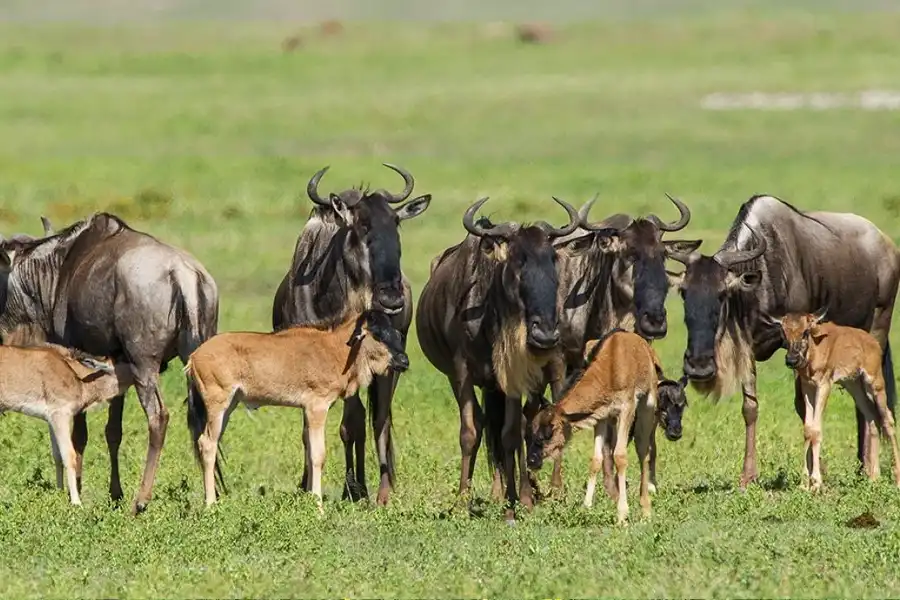
Ndutu is where the Great Migration begins its year. Between about December and March, the wildebeest and zebras come south to the short-grass plains on the border of the Ngorongoro Conservation Area and the southern Serengeti. The volcanic soils here make the grass rich in minerals, perfect for mothers and their young. Around February hundreds of thousands of calves are born within a few weeks, and the predators gather for the feast.
For many of our guides, this is the best safari of the year. You can sit with a herd and watch a calf being born and standing up within minutes, then turn around and see a cheetah stalking at the edge of the herd.
Where is Ndutu?
The Ndutu area lies in the south-west of the Ngorongoro Conservation Area, around two shallow soda lakes, Lake Ndutu and Lake Masek, and it runs seamlessly into the southern Serengeti plains. There is no fence or line on the ground: the herds move freely across the boundary. Because it is part of the Conservation Area, the rules are different from the national park: off-road driving is allowed in the Ndutu part of the plains, so your guide can follow the action.
Why go on safari in Ndutu
- Calving. The most concentrated births of any large animal on earth.
- Predator action. Lions, cheetahs, hyenas, jackals and leopards (in the woodland around the lakes) are all very active in the calving season.
- Cheetahs in particular: the open plains are one of the best places in Africa to see them hunt.
- Off-road driving lets you get into position without staying on the tracks.
- Green landscapes after the short rains, with dramatic skies.
The calving season month by month
| Month | What usually happens |
|---|---|
| December | Herds arrive on the southern plains as the short rains bring fresh grass |
| January | Herds settle; the first calves are born |
| February | Peak calving: thousands of births a day |
| March | Calves grow stronger; herds begin moving north-west as the plains dry |
Rainfall changes the pattern every year. In a dry year the herds may move away from Ndutu for a while and come back after rain. That is why we keep in touch with our guides in the field and pick camps close to where the herds are.
Outside the calving season
From about April to November the herds are elsewhere, and Ndutu becomes very quiet. Resident animals such as giraffes, elephants (around the woodland), lions and cheetahs remain, and the lakes attract birds. It can be a peaceful stop between the Ngorongoro Crater and the Serengeti, but the real magic is from December to March.
Tips for the calving season
- Stay at least three nights. Sightings depend on where the herds are each day.
- Take full-day game drives with a picnic, so your guide can follow the herds far from camp.
- Be patient. Births and hunts happen at their own pace; the best moments often come after a long wait.
- Respect the animals. Even with off-road driving, good guides keep a distance from mothers and calves, and never block a predator's hunt.
- Bring a zoom lens (around 100–400 mm) and a bean bag to rest it on the vehicle window.
Where to stay
There are a small number of permanent lodges around Lake Ndutu and seasonal tented camps that open only for the calving season. Book early: the best-placed camps fill up many months ahead.
Ndutu safaris
The calving season is a great time for a Great Migration safari. Combine three or four nights in Ndutu with the Ngorongoro Crater and Tarangire, and perhaps finish in Zanzibar.
Tell us your dates and we will plan your calving season safari. Read more: Great Migration safari guide.
Wildlife highlights
- Wildebeest calving (peak around February)
- Cheetahs
- Lions and spotted hyenas
- Zebras and gazelles
- Serval cats and bat-eared foxes
- Flamingos on Lake Ndutu and Lake Masek (seasonal)
Best time to visit Ndutu
- Jan: best
- Feb: best
- Mar: best
- Apr: possible
- May: possible
- Jun: possible
- Jul: possible
- Aug: possible
- Sep: possible
- Oct: possible
- Nov: possible
- Dec: best
Highlighted months are the best time to visit.
December to March is the calving season, with the peak of births around February and the best predator action of the year. From April to November the herds are elsewhere and Ndutu is quiet, with resident wildlife only.
How to get there
Ndutu is about 1.5–2 hours' drive from the Ngorongoro Crater rim, via the main road towards the Serengeti and a turn-off south of Olduvai Gorge. There is an airstrip at Ndutu with flights from Arusha and other Serengeti airstrips in the season.
Map
Ndutu: frequently asked questions
When is the calving season in Ndutu?
Usually between late January and March, with the peak around February. The herds are generally in the area from December to March, but the timing depends on the rains each year.
Is Ndutu in the Serengeti?
Partly. Most of the Ndutu area is in the Ngorongoro Conservation Area, on the border with the southern Serengeti National Park. The plains run into each other and the herds cross freely.
Can you drive off-road in Ndutu?
In the Ngorongoro Conservation Area part of Ndutu, off-road driving is allowed, which is a big advantage for following the herds. Inside the Serengeti National Park, vehicles must stay on the tracks.
What predators can I see in Ndutu?
Lions, cheetahs, spotted hyenas and jackals are very active during calving. Leopards live in the woodland around the lakes, and servals and bat-eared foxes are often seen.
How many days should I spend in Ndutu?
Three or four nights in the calving season, so you can follow the herds and wait for the best moments.
Questions about Ndutu?
Ask us anything. We will reply by email with ideas for your trip.
- Private trips planned around your dates and budget
- You see the full itinerary and price before you book